
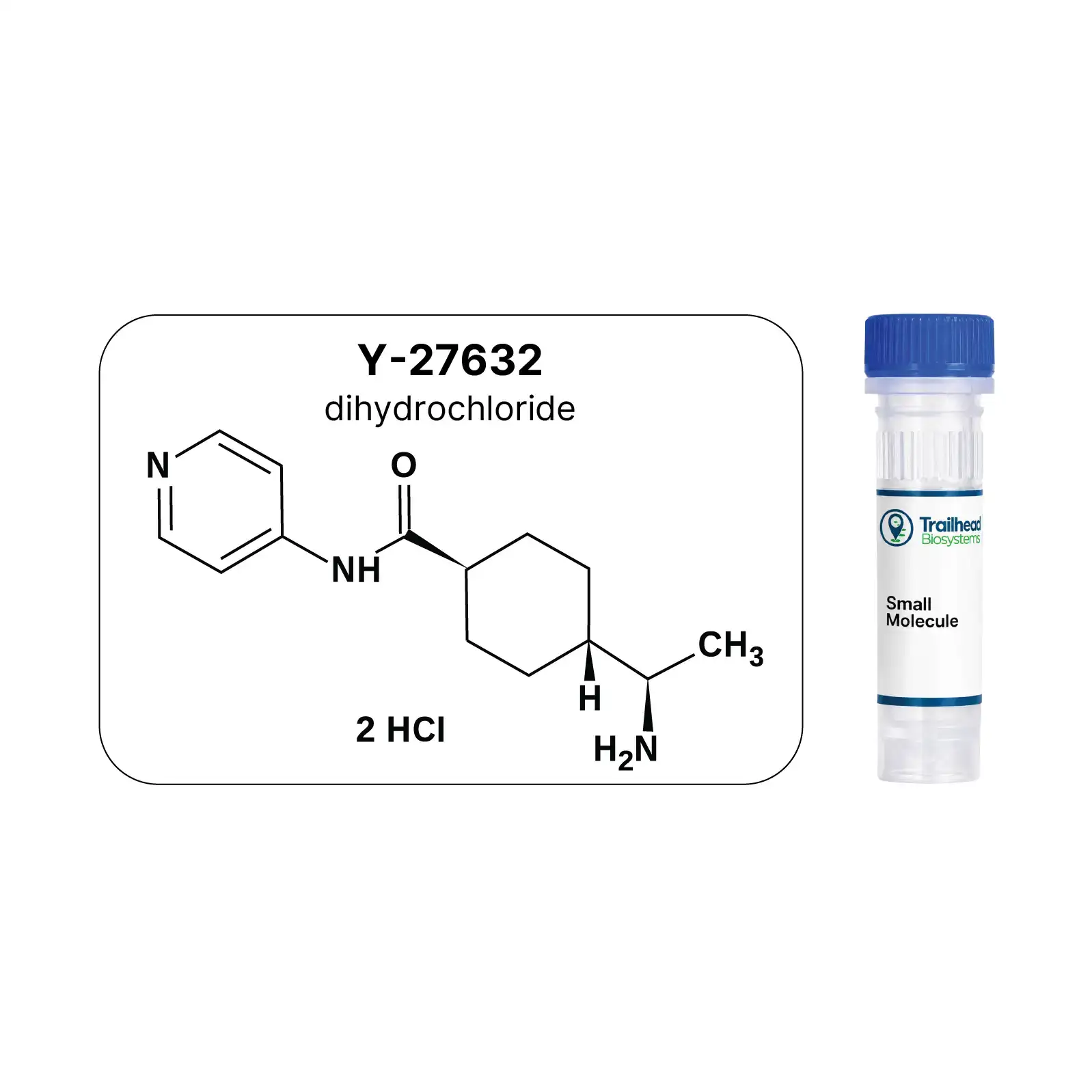
Description
Technical Information & Resources
Frequently Asked Questions
How is TrailBio® Y-27632 dihydrochloride used during thawing and passaging?
ROCK inhibition is commonly used to help reduce anoikis (detachment-induced apoptosis) during the critical recovery period after thawing or enzymatic dissociation into single cells. In human pluripotent stem cell workflows, TrailBio® Y‑27632 is typically added for the first 24 hours after thawing or single-cell passaging to improve attachment, survival, and recovery.
How is TrailBio® Y-27632 dihydrochloride used during cell sorting?
TrailBio® Y-27632 can significantly improve hPSC recovery after fluorescence-activated cell sorting, a process that can stress dissociated cells and reduce post-sort viability.
How is TrailBio® Y-27632 dihydrochloride used with TrailBio® cell and media products?
TrailBio® Endothelial Cells: Used during the initial thawing and subsequent passaging steps of endothelial cells to improve survival and proliferation.
TrailBio® Vascular Leptomeningeal Cells (VLMCs): Recommended for use during the initial plating of TrailBio® VLMCs to promote attachment and the formation of a confluent, functional barrier model.
How does TrailBio® Y-27632 affect iPSC morphology?
TrailBio® Y-27632 can cause a transient spindle-like morphology in iPSC colonies. This is a normal pharmacological effect on the cytoskeleton and will resolve once the medium is changed to one without the inhibitor.
How does TrailBio® Y-27632 affect HPC suspension cultures?
While TrailBio® Y-27632 is excellent for adherent cells, some research suggests it may negatively affect the expansion of CD34+ hematopoietic progenitor cells (HPCs) in suspension cultures. We recommend titration and careful monitoring when using TrailBio® Y-27632 with TrailBio® HPCs.
What concentration of TrailBio® Y-27632 should I use?
TrailBio® Y-27632 is commonly used in hPSC culture at 10 µM to support survival after thawing, single-cell passaging, or other stressful handling steps. Optimal concentration and exposure time should be determined for each workflow.
Supporting Publications
Watanabe et al. (2007), Nature Biotechnology.
- The landmark study establishing that ROCK inhibition permits the survival of dissociated human embryonic stem cells.
Li et al. (2008), Stem Cells Dev.
- Demonstrated that Y-27632 enhances the survival rate of iPSCs following cryopreservation.
- Demonstrated that the inclusion of Y-27632 improves recovery of hESCs post FACS sorting.
Narumiya et al. (2000), Methods in Enzymology.
- Provides the original biochemical characterization of the molecule.


