
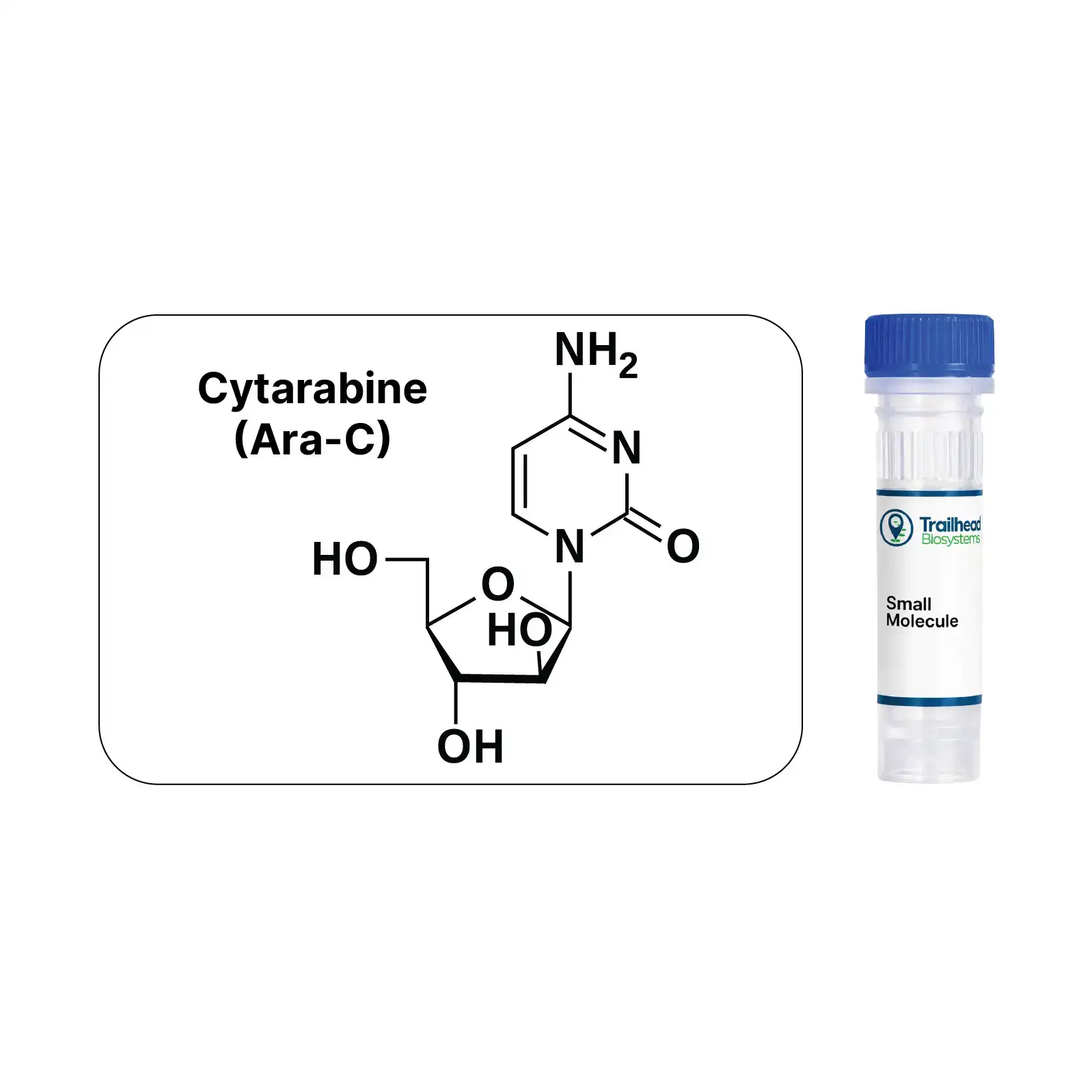
Description
Technical Information & Resources
Frequently Asked Questions
How should TrailBio® Cytarabine be used in post-mitotic cells?
While post-mitotic cells do not replicate, high concentrations of TrailBio® Cytarabine can interfere with mitochondrial DNA synthesis over extended timelines. For culture purification, a short, titrated pulse-dose (e.g., 24–48 hours) is recommended, rather than continuous exposure to preserve mitochondrial health.
How should TrailBio® Cytarabine stocks be prepared for cell culture?
Free base TrailBio® Cytarabine has limited solubility in water but is highly soluble in DMSO. When preparing high-concentration master stocks using DMSO, ensure the final DMSO concentration in cell culture media remains below 0.1% (v/v) to prevent cytotoxicity.
What readouts can be used to assess TrailBio® Cytarabine response?
Useful readouts include EdU/BrdU incorporation or DNA-content analysis for S-phase/DNA-synthesis effects, cleaved caspase-3 for apoptosis, and γH2AX for replication-stress/DNA-damage responses.
Supporting Publications
Roberts WK, Dekker CA. (1967), Journal of Organic Chemistry
- Roberts WK and Dekker CA developed a practical chemical synthesis for arabinosylcytosine, establishing a convenient route to produce the cytidine analog now known as cytarabine/Ara-C.
Graham FL, Whitmore GF. (1970), Cancer Research
- Graham FL and Whitmore GF showed in mouse L-cells that Ara-C incorporates into DNA and that its triphosphate metabolite inhibits DNA polymerase, helping define its mechanism as a DNA-synthesis-disrupting antimetabolite.


